

Umrah – A Complete Step-by-Step Guide
Introduction
Umrah, often called the “lesser pilgrimage”, is a journey of the heart to the House of Allah in Makkah. Unlike Hajj, it can be performed at almost any time of the year, and it takes only a few hours to complete — yet its rewards are immense. For many Muslims, Umrah is the first time they stand before the Kaaba, and the experience changes them forever.
In this guide, we will explain what Umrah is, how it differs from Hajj, how to prepare, and each ritual step by step, ending with the visit to Madinah and the common mistakes to avoid.
The Virtues of Umrah
Allah commands: “And complete the Hajj and Umrah for Allah.” (Quran 2:196) The Prophet Muhammad (peace be upon him) described its reward beautifully: “Umrah to the next Umrah is an expiation for the sins committed between them, and Hajj Mabrur (an accepted Hajj) has no reward except Paradise.” (Sahih Bukhari, Sahih Muslim)
He also encouraged performing it regularly: “Perform Hajj and Umrah in succession, for they remove poverty and sins just as the bellows removes impurities from iron.” (Sunan Tirmidhi, Sunan an-Nasa’i) And an Umrah performed in Ramadan carries a special rank — the Prophet (peace be upon him) said it equals a Hajj in reward. (Sahih Bukhari, Sahih Muslim)
Umrah and Hajj: What Is the Difference?
- Timing: Hajj happens only in the days of Dhul-Hijjah; Umrah can be performed throughout the year.
- Length: Hajj takes five to six days; Umrah’s rituals take a few hours.
- Rituals: Hajj includes Arafat, Muzdalifah, Mina, and the stoning; Umrah consists of Ihram, Tawaf, Sa’i, and cutting the hair.
- Status: Hajj is an obligation once in a lifetime for those who are able; Umrah is a strongly emphasised Sunnah according to many scholars, and obligatory once according to others.
Preparation Before You Travel
Prepare spiritually before you prepare your suitcase. Learn the steps of Umrah beforehand, seek forgiveness from people, clear your debts, and leave a will. Choose a reliable travel arrangement, pack light and comfortable clothing, unscented toiletries for the state of Ihram, comfortable sandals, and a small bag for your shoes inside the Haram. Most importantly, purify your intention: this journey is only for Allah.
Step 1: Ihram at the Miqat
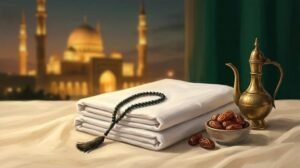
Ihram is both the special clothing of the pilgrim and the sacred state he enters. At the Miqat — the boundary points around Makkah, or earlier at the airport or hotel if flying in — the pilgrim makes the intention for Umrah and recites the Talbiyah: “Labbayk Allahumma labbayk…” (“Here I am, O Allah, here I am”). Men wear two unstitched white cloths; women wear their normal modest dress, without covering the face with niqab or wearing gloves while in Ihram.
From this moment, the rules of Ihram apply: no perfume or scented products, no cutting hair or nails, no hunting, no marital relations, and no arguing or foul language. The pilgrim keeps reciting the Talbiyah until reaching the Kaaba.
Step 2: Tawaf Around the Kaaba
Enter Masjid al-Haram calmly, and when you first see the Kaaba, take a moment — this is a time when duas are answered, so ask Allah for everything. Tawaf means circling the Kaaba seven times, keeping it on your left, beginning at the Black Stone. If possible, point towards the Black Stone at the start of each circuit and say “Bismillah, Allahu Akbar”. Between the Yemeni Corner and the Black Stone, many recite the famous dua: “Our Lord, give us in this world [that which is] good and in the Hereafter [that which is] good and protect us from the punishment of the Fire.” (Quran 2:201)
There is no fixed dua for each circuit — recite Quran, dhikr, and your own sincere duas in any language. After seven circuits, pray two rak’ahs behind Maqam Ibrahim if there is space, as Allah says: “And take, [O believers], from the standing place of Abraham a place of prayer.” (Quran 2:125) Then drink Zamzam water and make dua.
Step 3: Sa’i Between Safa and Marwah
Next, walk to Safa for Sa’i — seven lengths walking between the hills of Safa and Marwah, in memory of Hajar, the mother of Ismail (peace be upon him), who ran between these hills searching for water for her baby. Allah honours her search forever: “Indeed, as-Safa and al-Marwah are among the symbols of Allah.” (Quran 2:158)
Start at Safa, face the Kaaba, and make dua. Walk to Marwah — this is one length — then back to Safa for the second, ending after the seventh length at Marwah. Men walk briskly between the two green markers, as the Prophet (peace be upon him) did. Throughout Sa’i, remember Hajar’s trust in Allah: she searched with her feet while her heart knew Allah would not abandon her — and Zamzam sprang forth at her child’s feet.
Step 4: Cutting the Hair
After Sa’i, the Umrah is completed by cutting the hair. Men may shave the head completely (halq), which the Prophet (peace be upon him) prayed for three times with the words “O Allah, have mercy on those who shave their heads”, or trim the hair evenly from all over the head (taqsir). (Sahih Bukhari, Sahih Muslim) Women cut a fingertip’s length from the ends of their hair. With this step, you leave the state of Ihram and your Umrah is complete — may Allah accept it.
Visiting Madinah and Masjid Nabawi
Visiting Madinah is not part of the Umrah rituals, but it is the journey’s beloved companion. In Masjid Nabawi, the Prophet’s Mosque, one prayer is better than a thousand prayers in any other mosque except Masjid al-Haram. (Sahih Bukhari, Sahih Muslim) Pray in the Rawdah — the area the Prophet (peace be upon him) described as a garden from the gardens of Paradise (Sahih Bukhari, Sahih Muslim) — and give salam at his noble grave with full respect and calm manners. Also visit Masjid Quba, where praying two rak’ahs carries the reward of a complete Umrah. (Sunan Ibn Majah, Sunan Tirmidhi)
Common Mistakes to Avoid
- Pushing and harming others during Tawaf, especially near the Black Stone. Hurting a believer cancels the spirit of the act; pointing from a distance is enough.
- Believing fixed duas are required for each circuit, and reading from a phone or book so much that the heart is absent.
- Using scented soap or wipes after Ihram, or covering the head (for men) while in Ihram.
- Cutting the hair before Sa’i, or shaving only part of the head instead of trimming all over.
- Neglecting the five daily prayers or missing them in the Haram while busy with voluntary Tawaf — the obligatory prayer always comes first.
Tips for First-Timers
Go to the Haram early for each prayer, because it fills quickly. Keep a small bottle for Zamzam, stay hydrated, and agree on a clear meeting point with your group in case you separate. Do Tawaf on the upper floors if the ground floor is crowded — it is longer but calmer. Above all, guard your patience and your character: you are a guest in Allah’s House, so let every pilgrim you meet benefit from your kindness.
Conclusion
Umrah is a short journey with a lifelong effect: Ihram, Tawaf, Sa’i, and the cutting of the hair — four simple acts filled with the memory of Ibrahim, Hajar, and Ismail (peace be upon them) and the promise of sins forgiven. Prepare well, follow the steps of the Prophet (peace be upon him), fill the days with prayer and dua, and return home with a renewed heart. May Allah invite us all to His House, again and again, and accept it from us.