

The Life of Prophet Muhammad (PBUH) – Madinah Period
Introduction
The Makkah period of the Prophet’s life was about building faith under pressure. The Madinah period was about building a community, a state, and a civilization on that faith. After thirteen difficult years in Makkah, the Prophet Muhammad (peace be upon him) migrated to Madinah — an event so important that the Islamic calendar itself begins from it. The Hijrah was not an escape; it was a new beginning.
In this article, we will walk through the key events of the Madinah period: the Hijrah, the building of the first mosques, the brotherhood between the migrants and the helpers, the Charter of Madinah, the major battles and treaties, and the final days of the Prophet’s blessed life.
The Hijrah: Migration to Madinah
As persecution in Makkah grew unbearable, the Prophet (peace be upon him) permitted his followers to migrate to Yathrib — the city that would become Madinat an-Nabi, the City of the Prophet. The people of Yathrib had pledged to protect him, and one by one the Muslims left Makkah, often secretly and at great personal cost.
The Prophet himself left last, together with Abu Bakr (may Allah be pleased with him). The Quraysh had plotted to kill him that very night, but Allah protected him. The Quran describes how the disbelievers planned, “but Allah planned, and Allah is the best of planners” (Quran 8:30), and mentions the moment in the cave of Thawr when the Prophet comforted his companion: “Do not grieve; indeed Allah is with us” (Quran 9:40).
The Hijrah teaches us that sometimes faith requires sacrifice — leaving comfort, home, and wealth for the sake of Allah. The Muhajirun (migrants) gave up everything, and Allah honored them with the highest ranks.
Quba: The First Masjid
On the way to Madinah, the Prophet stayed a few days in Quba, a village just outside the city. There he built the first masjid of Islam — Masjid Quba. The Quran honors it as “a mosque founded on righteousness from the first day” (Quran 9:108).
The Prophet later said that whoever performs wudu at home and then prays two rak’ahs in Masjid Quba gets the reward of an Umrah. (Sunan Ibn Majah, Sunan Tirmidhi) This shows how much value Islam places on even the first small steps of building for Allah.
Building Masjid Nabawi
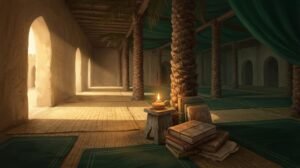
When the Prophet reached Madinah, his camel stopped at a spot belonging to two orphan boys. He bought the land and built Masjid Nabawi — the Prophet’s Mosque — with his own hands, carrying bricks alongside his companions. It was simple: walls of mud brick, a roof of palm branches, and a floor of gravel. But it became the heart of the new Muslim community — a place of prayer, learning, consultation, and shelter for the poor.
The Prophet also built his humble rooms next to the masjid. His home was small and simple, even though he was now the leader of a growing community. This simplicity remained his way until the end of his life, teaching leaders of all times that power in Islam means service, not luxury.
Muwakhat: The Brotherhood
One of the most beautiful events of the Madinah period was the Muwakhat — the pairing of each Muhajir (migrant from Makkah) with an Ansari (helper from Madinah) as brothers. The Ansar opened their homes, shared their wealth, and even offered to share their businesses and farms.
This was not just kindness; it was a new kind of bond. The Quran says: “The believers are but brothers” (Quran 49:10). The Muwakhat showed what that verse means in practice — that faith can create a family stronger than blood, where people sacrifice for one another purely for Allah’s sake.
The Charter of Madinah
To organize the diverse city — Muslims, Jews, and other tribes — the Prophet established a written agreement known as the Charter of Madinah. It defined the rights and duties of all citizens, guaranteed freedom of religion, and made all groups responsible for the defense of the city together.
Historians regard it as one of the earliest written constitutions in the world. It proves that Islam from its very beginning protected the rights of minorities and built society on justice and mutual responsibility, not on force.
Badr: The First Battle
In the second year after the Hijrah, the Muslims faced the Quraysh army at Badr. The Muslims were only 313 in number, poorly equipped, while the Quraysh were about a thousand strong. But the Muslims won a decisive victory.
The Quran reminds the believers that the victory came from Allah: “When you asked help of your Lord, and He answered you: Indeed, I will reinforce you with a thousand from the angels” (Quran 8:9). Badr teaches that numbers and weapons are not what decide outcomes — faith, preparation, and trust in Allah do.
Uhud and Khandaq: Tests of Patience
At Uhud, the Muslims suffered losses because some archers left their post against the Prophet’s orders, chasing the spoils of war. It was a painful but powerful lesson: victory comes through obedience and discipline, not through numbers.
At Khandaq (the Trench), the Quraysh and their allies besieged Madinah with a huge army. On the advice of Salman al-Farsi (may Allah be pleased with him), the Muslims dug a trench around the city — a new tactic in Arabia. Allah sent a fierce wind that scattered the enemy, and the siege collapsed. The Quran describes those fearful days and Allah’s help (Quran 33:9-11).
The Treaty of Hudaybiyyah
In the sixth year, the Prophet set out for Makkah to perform Umrah, but the Quraysh blocked the Muslims at Hudaybiyyah. Instead of fighting, the Prophet accepted a treaty that seemed unfavorable — including a clause to return any Makkan who came to Madinah. His companions were upset, but the Prophet saw further.
The Quran called it “a clear victory” (Quran 48:1). The treaty brought peace, and in those two peaceful years more people entered Islam than in all the years before. It teaches us that patience and wisdom can achieve what swords cannot.
The Conquest of Makkah
When the Quraysh broke the treaty, the Prophet marched on Makkah with ten thousand companions. The city that had tortured and expelled him surrendered without a major battle. Standing at the door of the Kaaba, the Prophet forgave his enemies — the very people who had killed his followers and driven him out. “No blame will there be upon you today,” he said, echoing the words of Prophet Yusuf (peace be upon him).
This general forgiveness is one of the greatest examples of mercy in human history. It shows that the strength of Islam lies not in revenge but in forgiveness.
The Farewell Sermon and Legacy
In his final year, the Prophet performed his last Hajj. On the plain of Arafat, he delivered the Farewell Sermon — a charter of human rights: the sanctity of life and property, the abolition of racism (“no Arab has superiority over a non-Arab”), the rights of women, and the duty to hold fast to the Quran and his Sunnah.
Shortly after returning to Madinah, the Prophet (peace be upon him) passed away in the room of Aisha (may Allah be pleased with her), beside the masjid he had built with his own hands. He was 63 years old.
Lessons for Us
The Madinah period shows us Islam in action: how to build a community, how to treat neighbors and minorities, how to face enemies with courage and forgive them with mercy, and how to lead with simplicity. The Prophet’s life in Madinah is not just history — it is a complete guide for building a just and compassionate society, and it remains relevant in every age.