

Introduction
Wherever a Muslim travels — a desert, a village, a new city or a journey through the mountains — one question always comes with prayer: which way is the Qiblah? The Qiblah is the direction of the Kaaba in Makkah, the sacred house built for the worship of Allah alone. Facing it in prayer unites more than a billion Muslims around the world in a single direction, five times a day.
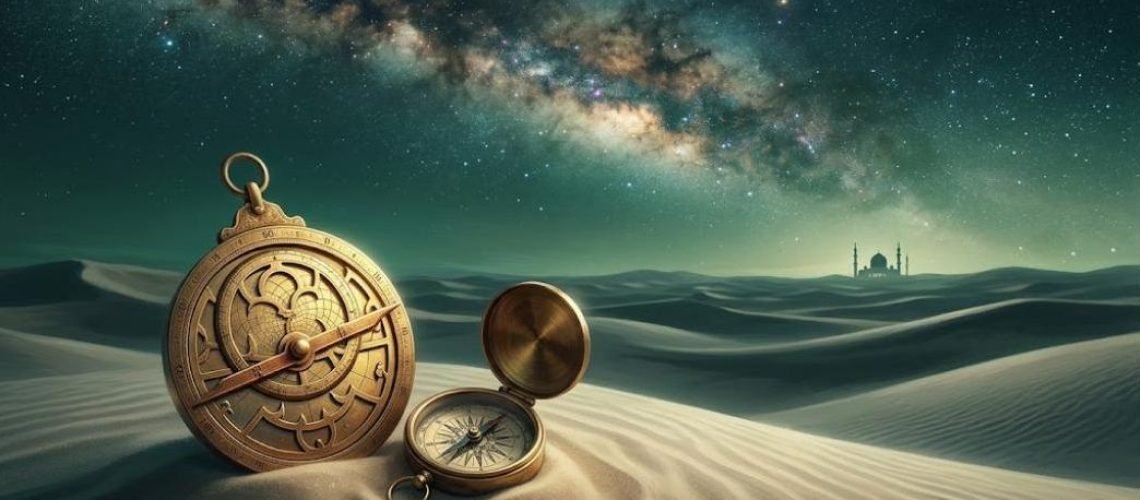
Today, most of us simply open an app. But what if there is no phone, no signal and no masjid nearby? For centuries, Muslims found the Qiblah by reading the sky — the sun by day and the stars by night. In this article we will learn the history of the Qiblah, and then simple, practical methods to find its direction with the sun, the stars and a compass.
The History of the Qiblah
In the early period in Madinah, the Muslims prayed facing towards Jerusalem. Then Allah revealed the command to turn towards the Kaaba in Makkah. Allah says: “We have certainly seen the turning of your face, [O Muhammad], toward the heaven, and We will surely turn you to a Qiblah with which you will be pleased. So turn your face toward Al-Masjid Al-Haram. And wherever you [believers] are, turn your faces toward it” (Quran 2:144).
From that day until today, the Kaaba has been the Qiblah of this Ummah. Facing it does not mean we worship the Kaaba itself; we worship Allah alone, and we face the Kaaba because Allah has commanded it. The shared direction is also a beautiful sign of unity: a Muslim in Pakistan, another in Turkey and another in Indonesia all turn towards one centre in prayer.
Allah also praised the stars and natural signs as a means of guidance for travellers. He says: “And landmarks. And by the stars they are [also] guided” (Quran 16:16). Muslim astronomers of the past took this guidance seriously, and they became experts in calculating the Qiblah for distant lands using mathematics and the movement of the sun.
Method 1: Finding Direction From the Sun
The sun gives us the four directions every clear day.
Sunrise and Sunset
The sun rises in the east and sets in the west — approximately, though the exact point shifts a little with the seasons. If you stand facing the sunrise in the morning, east is in front of you, west behind you, north on your left and south on your right. From these four points you can estimate the direction of Makkah from your country. For example, from Pakistan and India the Qiblah is towards the west, slightly towards the north-west. From the United Kingdom it is towards the south-east, and from North America towards the north-east. Knowing the general Qiblah direction of your region is the key, and the sky gives you the compass points to apply it.
Using the Sun at Midday and Shadows
Around the middle of the day the sun is roughly in the south for people in the northern hemisphere, and roughly in the north for people in the southern hemisphere. A stick pushed upright into flat ground will cast a shadow, and the shortest shadow of the day falls close to solar noon. Watching how the shadow moves also shows the east-west line: the morning shadow points west and the afternoon shadow points east.
The Two Special Days of the Year
Twice a year, around 28 May and 16 July, the sun passes directly above the Kaaba at midday in Makkah. At that exact moment, anywhere in the world where the sun is visible, the direction of the sun is exactly the direction of the Qiblah, and a vertical stick’s shadow points exactly away from the Qiblah. Muslims and masjids have used these days for centuries to check and correct their prayer direction, and many Islamic calendars still announce them each year.
Method 2: Finding North From the Stars
On a clear night, the stars can tell you where north is.
In the northern hemisphere, the most useful star is Polaris, the North Star. It stays almost fixed above the North Pole while other stars appear to move around it. To find it, first locate the well-known group of stars called the Plough or Big Dipper, which looks like a large saucepan. The two stars at the front edge of the pan point almost directly to Polaris. Once you face Polaris, you are facing true north — south is behind you, east on your right and west on your left — and from there you can work out the Qiblah direction for your location.
In the southern hemisphere there is no bright pole star, so travellers use the Southern Cross constellation to estimate south. These methods are approximate, but for a traveller with nothing else, an honest effort made to the best of one’s ability is accepted, because Allah does not burden a soul beyond its capacity (Quran 2:286).
Method 3: Using a Compass or App Correctly
A compass points to magnetic north, which is slightly different from true north; the difference is called magnetic declination and changes from place to place. Good Qiblah compasses and reliable apps already make this adjustment. When using a compass, keep it away from mobile phones, keys, cars and other metal objects, hold it flat, and let the needle settle before reading the Qiblah bearing given for your city.
What If I Cannot Find the Exact Direction?
Islam is a practical religion. A person who is travelling should try his best using the signs available — the sun, stars, a compass, asking local people or checking a masjid’s direction. If after genuine effort he prays in the direction he believes is correct, his prayer is valid, even if he later learns the exact direction was slightly different. What matters is sincere effort, not impossible perfection.
Conclusion
The sky above us is one of Allah’s great signboards. The same sun and stars that guide sailors and travellers also guide the believer to the Qiblah, just as they guided generations of Muslims before telephones and satellites existed. Learning to read them connects us to the history of this Ummah and makes us less helpless in a journey or an unfamiliar place. Next time you are outdoors, look up: note where the sun rises, find the North Star at night, and work out the direction of the Kaaba for yourself. In every direction we turn, we remember that the purpose is one — to face the House of Allah and worship Him alone.